Interview Preparation: A Four Week Plan You Can Compress
A four week interview preparation plan covering research, stories, delivery, nerves and logistics, plus how to compress it into one week or three days when that is all the time you have.



In this article · 8 sections
- The five things preparation has to cover
- Week one: research and raw material
- Week two: turning material into answers
- Week three: say it out loud
- Week four: nerves, logistics, rest
- Interview day and the day after
- Compressing the plan
- Mistakes that waste preparation time
Practise for your next interview free, with no card.
Sign up freeMost interview preparation is a pile of half-remembered questions and a skim of the company website the night before. A plan is better, and it does not have to be elaborate. It has to cover the things an interview actually tests, in an order that gives each one time to settle.
What follows is a four week plan, and almost nobody gets four weeks, so the last section compresses it into one week or three days. The sequence survives compression better than the content does: gather material, shape it into answers, say those answers out loud to someone or something that pushes back, then rest.
The five things preparation has to cover
- Research: the company, the role, and where you can, the people interviewing you
- Content: the stories and answers you will actually use
- Delivery: saying those answers aloud, in time, without waffling
- Nerves: being able to think clearly while your pulse is up
- Logistics: the boring things that ruin an otherwise good interview
Most people spend all their preparation on the second one. That is why a well qualified candidate can still interview badly: they know what they want to say and have never once heard themselves say it.
Week one: research and raw material
The company and the role
Give this half a day, not a weekend. You are looking for specifics you can use in an answer, not general familiarity.
- Read the last year or two of whatever they publish about themselves: investor letters, an engineering blog, release notes, case studies.
- Read news coverage from the past six months. Funding, layoffs, a new product line and a change of leadership all shape what the team is under pressure to do.
- Look at the product properly. Use it if you can. Form an opinion about one thing in it.
- Check employee review sites for the recurring complaints, not the star rating. The same grumble appearing five times is information.
Then take the job advert apart line by line. Separate the requirements you meet strongly from the ones where you are thin, and rank them by how central they look rather than by the order they were written in. Adverts are written by committee, so the thing mentioned three times in different words is the real requirement.
You should end up with a page: ten concrete facts about the company, a few problems you believe the team has, and the requirements ranked. That page is the raw material for every "why us" answer you give.
The people in the room
If you know who is interviewing you, spend an hour on their public professional profiles. Not a dossier: you want to know what each one is likely to care about, because an engineering manager and a product lead hear the same answer and weigh different parts of it. Having a question ready that only makes sense to ask that particular person is worth more than another hour of generic practice.
Your story bank
Go through your career in order and write down everything that might be usable: projects, things that went wrong, arguments you resolved, times you taught someone, times you changed your mind. Do not filter yet, because people routinely forget their second best example purely because it happened three jobs ago. For each, capture the context, what you owned, what made it hard, what you did, what happened, and what you would do differently. That last field is what saves you when an interviewer follows up.
From that list, build eight to twelve stories you can tell properly: a real achievement, leading something, a hard problem, a failure, a conflict, a cross team collaboration, a time you worked without clear direction, and something technical you can go deep on. Several categories can share one story if the story is rich enough, and twelve mediocre stories are worse than eight you know cold.
Shape each with STAR and keep the proportions honest: a sentence or two of situation, a sentence of task, the bulk of it on your actions, a clear result at the end. Most weak answers are weak because the situation eats half the time. Aim for two to three minutes spoken, and time one, because that is longer than you think.
Week two: turning material into answers
Behavioural questions
Map your stories onto the usual categories: leading a project, influencing without authority, handling someone who was not performing, learning something fast, working with ambiguity, resolving a disagreement, explaining something complex to a non expert, your biggest accomplishment, a project that failed, feedback that was hard to hear.
Write each answer out in full once, then never read it again. Writing it forces the structure. Reading it back repeatedly is how you end up reciting. When you practise, work from the four STAR beats, not the script.
Check two things in every behavioural answer: that you say "I" where you mean I, and that the result is specific. Teams do things, but interviewers are hiring you, and a vague ending ("it went well, the client was happy") is the most common reason a good story lands flat.
The role specific part
This is where the plan diverges by discipline, and where your largest block of time should go.
- Engineering and data: the fundamentals you are rusty on, problems under time pressure, system design if the level calls for it, and a rehearsed explanation of the most interesting technical decision you have made and why you would not make it the same way today.
- Product: product sense prompts, estimation, how you prioritise and why, and a critique of a product you use daily, including theirs.
- Business and strategy: case structure, the metrics that matter in their market, and a defensible view on one problem you think they have.
- Design: the portfolio walkthrough as a spoken narrative rather than a slide tour, and an honest critique of your own past work.
The standard questions
These come up almost every time and are the cheapest points available.
"Tell me about yourself." Present, past, future. Where you are now and what you own, the two or three steps that got you here and why each move made sense, then why this role. Two to three minutes, no more. This answer sets the interviewer's mental model of you, and everything after it gets filed against that model.
"Why this company?" Requires the research page. A specific thing they do, a genuine reason it interests you, and the connection to the work you want to be doing. If your answer would work for any company in the sector, it is not an answer.
"Why are you leaving?" Say what you are moving towards. You need not be dishonest about a bad situation, but what you want next is more useful to them than what you are escaping.
"What is your weakness?" Pick a real one that does not disqualify you, and describe the specific thing you now do about it. The transparent non answer wastes a question everyone knows is coming.
Salary expectations. Research the market range and decide your number before you are asked, and have a polite way to defer if it comes up before you have any leverage. Deciding this live is how people cost themselves money.
The questions you ask
Prepare more than you need, because half of them get answered during the conversation. Useful ones tend to be concrete: what does success look like in the first ninety days, what is the team's biggest constraint right now, how are disagreements settled, what would make you certain you hired the right person. Add two or three that only exist because of your research. Those are the ones that get remembered.
Week three: say it out loud
This is the week that changes your performance, and the week most people skip.
Alone, recorded
Record yourself answering, then watch it. Unpleasant, and the fastest feedback available. You are checking length, whether you reached the result before you ran out of steam, how often you say "we" when you mean "I", and whether you sound like a person or a press release.
With something that marks you
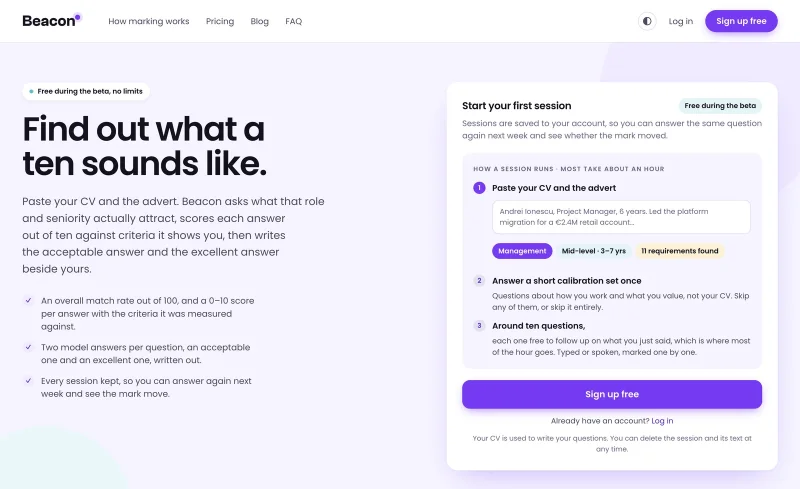
Self review has a ceiling: you cannot see the gap you do not know is there. That is what Beacon is for. You paste your CV and the real advert, and it generates questions for what that role and seniority actually attract. Each answer is marked out of ten against criteria it shows you rather than hides, and beside your answer it writes two model answers, an acceptable one and an excellent one, so you can see the distance. Behavioural answers are assessed against STAR, and spoken answers are transcribed and marked exactly like typed ones. Sessions are kept, so you can answer the same question again next week and compare the marks. It is free during the beta, with no card and no limits.
Answering a question again days later rather than once is the spacing effect, and it is the difference between recognising your answer and producing it under pressure. Anders Ericsson's work on deliberate practice makes the same point from the other side: repetition only improves you when the feedback is specific enough to act on.
With a person
Two or three full mock interviews with someone in your field, at least one with a person willing to be blunt. Do the last one in the room you will actually use, at the length you expect, dressed as you will be dressed. The point is to make the real thing feel like a repeat rather than a first.
Week four: nerves, logistics, rest
Find a calming technique and practise it before you need it. Box breathing (in for four, hold for four, out for four, hold for four) is popular because it is unobtrusive and you can do it in a corridor. What matters is that it is familiar by interview day, not novel. More useful than any technique is reframing: two parties are deciding whether to work together, the vacancy is costing them something, and one interview settles nothing about your worth. That is not positive thinking, it is accurate.
Then the boring list, which sinks more interviews than nerves do. Remote: test camera, microphone and connection on the actual platform, put your lighting in front of you rather than behind, and have a fallback ready (a phone hotspot or a second device). In person: know the route, the building and the floor, add a buffer, and bring clean copies of your CV. Choose the outfit the day before and put it on once to be sure.
The day before, review lightly for an hour and then stop. Cramming trades sleep for recall you will not have anyway.
Interview day and the day after
In the morning, skim your notes for ten minutes, not an hour, and arrive or log in early enough that a problem is survivable. Answer the question first and then support it with the story, rather than telling the story and hoping the point emerges. Pause before the hard ones: a three second silence feels enormous to you and normal to them. Ask for clarification when a question is ambiguous, because guessing wrong and answering fluently is worse than asking.
Write everything down within an hour of finishing: the questions asked, who asked them, what you promised to send, which answers came out badly. That record is worth more than your feeling about how it went, which is usually wrong in both directions, and it is the raw material for the next interview.
Send a short thank you within a day: something specific from the conversation, one concrete reason you are still interested, a few sentences. Then send anything you promised, promptly, because that is a small test and people notice.
Compressing the plan
Four weeks is a luxury. The order survives compression better than the content does.
- Two weeks: three days research and story bank, four days building answers, five days practising aloud with feedback, two days logistics and rest.
- One week: two days research and stories, two days on the standard questions and the role specific block, two days practice, one day logistics and rest.
- Three days: research and six stories on day one, the standard questions and one practice round on day two, logistics and rest on day three. Six good stories beat twelve half remembered ones.
Whatever you cut, do not cut the out loud practice. Reading your answers silently produces the confidence of preparation without any of the benefit.
Mistakes that waste preparation time
- Memorising. A recited answer sounds recited and collapses on the first follow up. Prepare beats, not sentences.
- Generic research. If your research does not change a single answer, it was reading, not preparation.
- Rehearsing in your head. Thinking an answer and saying it are different skills, and only one of them is assessed.
- No feedback. Practice without feedback mostly rehearses your existing habits, including the bad ones.
- One interview, all hopes. Keep other processes running. It improves your interviewing as much as it protects your outcome.
An interview tests three things at once: whether you can do the job, whether you can explain that you can, and whether working with you would be bearable. Preparation is the one of the three you can most change in a month. It is worth the month, and it is worth the three days if that is all you have.