How to Read the Tech Hiring Market for Yourself
Hiring trend reports quote figures nobody can trace and expire within a year. The job advert in front of you is better evidence. Here is how to read it, what company type actually changes about the interview, and which questions get you real answers.



In this article · 8 sections
- The advert is your primary source
- The same job title is several different jobs
- What interviews tend to ask of you now
- Red flags you can spot from inside the process
- Researching a company properly
- Evaluating an offer beyond the base salary
- Staying ready between searches
- The part that does not expire
Practise for your next interview free, with no card.
Sign up freeMost writing about the tech hiring market is unfalsifiable. It quotes a figure nobody can trace, treats the process at a handful of very large employers as if it were the whole industry, and goes stale within a year. You can do better than that, because the market you actually face is observable: the adverts you read, the processes you sit, and the answers you get when you ask questions.
There are no market statistics in this piece, because we have none we can stand behind. What follows instead is a method: how to work out, for the specific role in front of you, what is being tested, what the job really is, and what to do about it before the first call.
The advert is your primary source
A job advert is the most reliable document you will get about a role, and most candidates skim it once and never return. Read it the way you would read a requirements document, because that is what it is.
What the ordering tells you. Requirements are usually listed roughly in the order the person writing them was thinking about the problem. The first three bullets are the job. The last five are a wish list assembled by committee. If the first thing mentioned is migrating a legacy system, the interview will be about migrating legacy systems, whatever the job title says.
What gets repeated. Scan for the idea that appears twice in different words: "works well with ambiguity" in the intro and "comfortable making decisions without complete information" in the requirements. Repetition is the hiring manager telling you what went wrong with the last person in the seat, or what is hard about the team right now. Prepare a story for it.
Who wrote it. Adverts written by an engineering manager read differently from adverts written by a recruiting team. Specific systems, specific team size, specific problems mean the manager had a hand in it, and your answers should be specific back. Generic phrasing across a dozen adverts from the same company means you will be screened against a checklist first, so the plain keywords matter more.
What is missing. No mention of testing, on call, code review or documentation in a senior backend advert is information. Either those things are not practised or they are not valued enough to advertise. That is a question for the interview, not a reason to walk away.
The seniority language. "Contribute to", "own", "define" and "set the direction for" are four different jobs. Match your examples to the verb. Someone applying for an owning role who only tells stories about contributing is going to be marked down without ever being told why.
The same job title is several different jobs
Company type shapes the interview more than the technology stack does. These differences are structural rather than seasonal, so they hold up better than any snapshot of who is hiring this quarter.
Very large tech companies
Long processes, multiple rounds, standardised rubrics, and often a hiring decision made by a committee that never met you. That last detail matters more than people realise: your interviewer is writing notes for someone else to read, so an answer that was clear in the room but vague on paper loses you the role. Say the structure out loud. State the constraint, state the approach, state the trade off, state what you would measure. Expect system design earlier in your career than you would elsewhere, and expect behavioural rounds mapped to a published set of company values that you can read in advance.
Funded, fast growing companies
Shorter processes, more weight on whether you can operate without scaffolding. The questions tend to be practical: here is a real problem we had last month, what would you do. What they are testing is whether you will need a year of ramp up. Prepare examples where you started with an unclear brief and shipped something anyway, and be honest about what you cut to get there. Ask what happens when priorities change mid quarter, because they will.
Early stage companies
The process is whatever the founder decides it is, which means it varies from a single conversation to a working session on a live problem. The bar is usually range rather than depth: can you take a product question, a data question and a deployment question in the same afternoon. The interview is also your only real chance to assess the company, so use it. Ask about runway, about how the last two hires worked out, and about who makes product decisions.
Large, established, non fashionable companies
Predictable processes, mature rubrics, and a genuine interest in whether you will still be there in three years. Fundamentals are assessed properly rather than exotically. The risk here is under preparing because the brand is unglamorous, then being caught out by a thorough, well run process.
Consultancies and agencies
Technical breadth is assessed, but the real filter is client facing competence. You will be asked how you handled a client who wanted the wrong thing, and how you explained a technical constraint to someone with no technical background. Those answers need to be as rehearsed as your system design.
What interviews tend to ask of you now
These are patterns candidates report encountering, not measured trends. Treat them as things to be ready for rather than as facts about the market.
Automated first passes. Plenty of applications are filtered before a person reads them. The practical consequence is narrow: use the same words for a technology that the advert uses, and put them where they can be found rather than only in a skills graphic.
Structured rubrics. Larger and more mature processes score you against named criteria rather than overall impression. This is good news, because criteria can be prepared for. Ask the recruiter what each round assesses. Most will tell you, and the ones who cannot are telling you something too.
Take home work. More common, and more often replacing an onsite round than adding to one. Ask two things before you accept one: how long it should take, and whether it is paid if it runs long. Then keep to the stated time and write down what you would have done with more of it. The note explaining your trade offs is frequently worth more than the code.
Practical over puzzle. Debugging exercises, code review exercises and extending an existing small codebase have become common alternatives to abstract algorithm questions. Practise reading unfamiliar code under mild time pressure, which is a different skill from writing code from scratch.
Behavioural rounds with a defined shape. Where companies publish their values or competencies, the behavioural round maps to them almost line by line. Read them, then map two of your own stories onto each one. Keep the stories in STAR form: the situation, the task, what you personally did, and the result with a number in it if you genuinely have one.
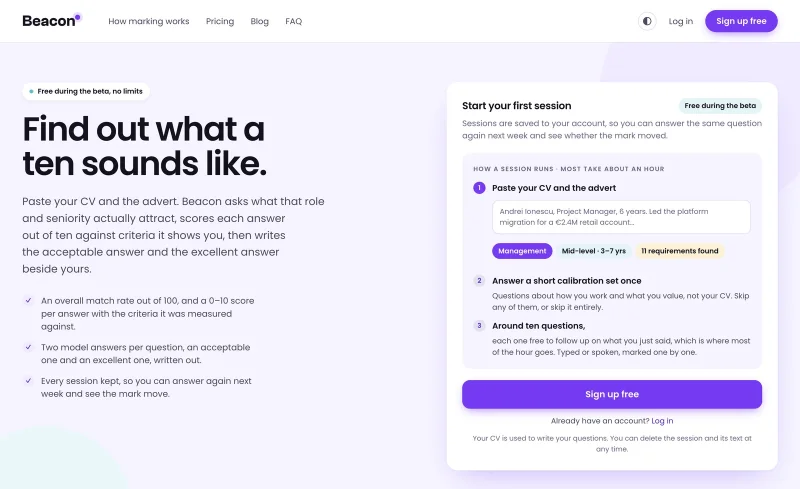
Practising against the actual advert rather than a generic question bank is the point at which most preparation goes wrong. Beacon exists for that specific gap: you paste your CV and the real advert, it works out what that role and seniority actually attract and generates questions for it, and it marks each answer out of ten against criteria it shows you rather than hides. Alongside the mark it writes an acceptable answer and an excellent answer next to your own, so the gap is visible instead of implied. Answers can be typed or spoken, and spoken ones are transcribed and marked the same way. It is free during the beta, with no card and no limits.
Red flags you can spot from inside the process
These are observable in any process, whatever the market is doing.
- Interviewers who have clearly not read your CV, repeatedly, not once
- Nobody can describe the role in the same terms as anybody else
- Vague or evasive answers about funding, runway or the path to profitability
- Repeated rescheduling at short notice
- An offer with a deadline short enough to prevent you finishing other processes
- Refusal to discuss a compensation range at any stage
- No one will say why the role is open, or how long it has been open
- The manager cannot describe what good looks like after six months
None of these is disqualifying on its own. Two or three together usually mean the team is in more trouble than the advert admits, and you will inherit that trouble.
Researching a company properly
Public sources will tell you more than most candidates bother to find out.
- Funding databases for the funding history, the last round size and its date. A long gap since the last raise is a fair thing to ask about.
- Professional networks for headcount direction. Whether the engineering team has grown or shrunk over the past year is usually visible, as is how long people stay.
- Review and salary aggregation sites for compensation bands and interview reports. Individual reviews are noisy. Repeated specific complaints are signal.
- The engineering blog and public repositories for how they actually work. A blog that stopped two years ago tells you something about where the attention went.
- Former employees for everything else. A short, specific message asking two questions gets answered more often than people expect.
Then use your own questions in the interview, which are data collection rather than politeness. What is the biggest problem the team has right now. How is success measured for this role. What does the on call rotation look like. What is the approach to technical debt. What do the people who do well here have in common. Listen for whether different interviewers give you compatible answers.
Evaluating an offer beyond the base salary
Base salary is the number that is easiest to compare and rarely the one that decides whether you are happy in a year. Write down the dimensions that matter to you, weight them before you have an offer in hand, and score each option against them afterwards. Doing it in that order stops a single large number from reorganising your priorities.
The dimensions worth pricing: equity, including the vesting schedule, the strike price if they are options, and what the last valuation actually was. Bonus structure and whether it has historically paid out. Health cover, pension contribution and leave, which vary enormously. Expected hours and the reality of them. Remote or hybrid arrangements, and whether they are written into the contract or subject to change. Who you would learn from. Whether you can describe the work to someone else without apologising for it.
For equity in a private company, ask for the number of shares, the total shares outstanding and the last preferred price. If those questions are refused, treat the equity as worth nothing when comparing offers, because you have no way to value it.
Staying ready between searches
The best time to look is when you do not have to, and the difference between those two situations is mostly preparation done in advance.
- Write down what you did every quarter while you still remember the details. The result, the constraint, and your specific part in it. Reconstructing this two years later is where good work turns into vague claims.
- Keep the CV current rather than rewriting it in a panic. Fifteen minutes a quarter.
- Stay in touch with a few former colleagues for reasons unrelated to jobs. This is the part everyone skips and it is the part that produces most interviews.
- Interview occasionally when you are not desperate. Nothing else calibrates your market position as accurately, and you find out what is being asked before it matters.
- Keep a small amount of practice going. Answering the same question again months later and comparing it to your earlier answer shows you whether you are actually improving or just repeating yourself, which is why every session in Beacon is kept.
The part that does not expire
Hiring conditions change, and any specific claim about them dates quickly. What does not change is that a clear, specific, well structured answer beats a vague one, that preparing against the real advert beats preparing in general, and that the candidate who asks better questions learns more about the company than the company learns about them.
Start with the advert in front of you. Everything else follows from reading it properly.