Career Development and Job Search Strategy
A practical guide to managing a career on purpose: deciding what you are aiming at, staying ready for opportunities, running a targeted job search, negotiating the offer, and changing direction without losing ground.



In this article · 8 sections
- Deciding what you are actually aiming at
- Career capital: why some people have options
- Staying ready
- Running a targeted search
- Evaluating and negotiating an offer
- Changing direction
- Keeping the skills growing
- Where to start
Practise for your next interview free, with no card.
Sign up freeMost people manage their careers reactively. The CV gets updated when a search starts, the network gets contacted when something is needed, and the next role is whichever one turns up first. That works, up to a point. It also means your career is shaped mostly by what happens to come along.
Deciding what you are actually aiming at
Most people cannot describe what they want from work beyond "more money" or "somewhere better". That vagueness makes every opportunity look roughly equivalent.
Rank what you are optimising for
These five pull against each other, and you cannot have all of them at once:
- Impact: work that matters to you, against work that pays best
- Growth: rapid learning, against mastery and stability
- Autonomy: independence, against structure and guidance
- Balance: a life outside work, against career intensity
- Recognition: visibility and status, against quieter contribution
Put them in order. If you rank balance first and then take the role with the longest hours because the title is better, you have learned something useful about your real ranking.
Pick a shape and a track
Deep specialist, broad generalist, or T-shaped (broad working knowledge, genuinely deep in one thing): all three are viable, and the failure mode is drifting between them by accident and ending up shallow everywhere.
The same goes for the individual contributor track (senior, staff, principal) and the management track, which are different jobs rather than different levels of the same job. Choosing one does not lock you in, but drifting into management because it was the only promotion on offer is how people end up doing work they dislike for a decade.
Write it down as one sentence
Fill this in: in [timeframe] I want to be [role] at a [type and stage of company] in [industry], doing [the core responsibility]. That fits my priorities of [your top two or three] and builds expertise in [skill areas].
The value is not the sentence. It is that you can hold an offer up against it and get an answer instead of a feeling.
Career capital: why some people have options
Cal Newport's term for this is career capital: the rare and valuable things you can offer. It is why some people have opportunities arriving unprompted while others are sending applications into the void. It comes in three forms.
- Skill capital is what you can actually do. The useful filter is rare and valuable, because plenty of skills are one without the other.
- Network capital is the set of people who would vouch for your work. It is built by being useful to people before you need anything from them, which is why it cannot be assembled in the fortnight after a redundancy.
- Credibility capital is the evidence: things you shipped, problems you fixed, work visible outside your own team. Excellent work nobody knows about does not build it.
Early years go into skill, middle years into relationships, later years into using the track record to reach work you could not otherwise access. The common mistake is spending a whole career on the first one and wondering why nothing arrives.
Staying ready
People who move well do not start job searches. They are simply always in a position to take a call.
- Keep a wins file. What you did, with the numbers attached, written while you still remember them. Reconstructing three years of impact from memory in a panic produces a much worse CV than five minutes a month would have.
- Update the CV quarterly, whether or not you are looking. Ten minutes when it is current, a weekend when it is not.
- Stay in touch with people you liked working with, before you want something. Contacting someone after four years of silence to ask for a referral is a bad trade for both of you.
The benefit is not speed. It is that you can be selective rather than desperate, which changes every conversation that follows, including the one about pay.
Running a targeted search
Build a list before you apply to anything
Applying to everything vaguely matching is the least effective use of the time. Build a list of companies that fit the sentence you wrote earlier, judged on stage and trajectory, the work itself, remote policy, likely pay band, and the people you would learn from.
For each, find out what they have shipped recently, what problem they are visibly trying to solve, and what past candidates say about their process. Track it in one place: company, role, why you care, who you know there, where the application stands, next action.
Tailor the CV, skip most cover letters
Every application should emphasise the experience relevant to that advert:
- Header: name, email, phone, profile or portfolio links
- Summary: two or three sentences on your role, your experience in the relevant area, and the kind of results you produce
- Experience: your two or three most recent roles, each with a few bullets that lead with the outcome and the number attached to it, not the responsibility
- Skills: languages, frameworks and tools, if the role is technical
- Education: degree, institution, year
Start bullets with a verb, quantify wherever you honestly can, and keep it to one page unless you have a decade behind you. Avoid tables, columns and graphics: plenty of applicant tracking systems read them badly, and you will never find out that was why.
Most cover letters are not read. Write one only when the application requires it, when you have a real connection or a specific reason for this company, or when you need to explain a career change or a gap. Under 250 words: why this company, your most relevant qualification with evidence, and a request to talk.
Referrals are worth more than volume
An application that arrives through someone who already works there gets looked at properly. One through the front door often does not. Spend your effort where you know someone, or know someone who does, and ask plainly: "I am interested in [role] at [company]. Would you be comfortable referring me, or introducing me to the hiring manager?" A clear question is easier to answer than a hint.
Beyond that, apply directly to the places you genuinely want, and talk to internal and specialist recruiters. Follow up once after a week, then move on.
Prepare while the applications are out
The gap between applying and interviewing is the time you have. Research each company, build a bank of stories about your own work, and rehearse out loud rather than in your head. Answers that felt solid while you were thinking them tend to fall apart when you have to say them.
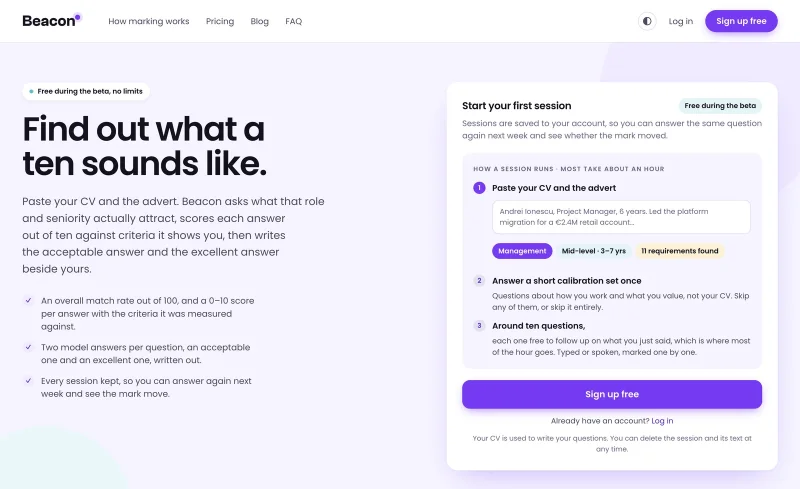
Beacon is one way to do that. You paste your CV and the real job advert, and it generates questions for that role and seniority, then marks each answer out of ten against criteria it shows you rather than hides. Beside your answer it writes two model answers, an acceptable one and an excellent one, so you can see what the gap actually is. Type or speak: spoken answers are transcribed and marked identically, and behavioural answers are assessed against STAR. Sessions are kept, so you can answer the same question a fortnight later and compare. It is free during the beta.
Evaluating and negotiating an offer
Score the whole package, not the salary
- Compensation: base, equity (value, vesting, strike price), bonuses, pension contributions, holiday, health cover
- Growth: what you will learn, who you will learn it from, where the role leads
- Environment: culture, hours, remote policy, the team you would sit with
- Impact: how important the work is, how much of it you own
A higher base somewhere you stop learning is usually the worse deal over five years, and equity is frequently worth less than the headline suggests. Ask what the strike price is and what the last round valued the company at.
Negotiate, because it is expected
Research the market first: salary aggregators for your industry, anonymous industry forums, and, most usefully, people in your network doing that job in that market. Then:
- Lead with enthusiasm. You want the job. Say so.
- Try to hear their number first. "What is the budgeted range for this position?" is a normal question.
- If they insist you go first, give a researched range and say you are flexible on the shape of the package.
- Do not answer on the call. Thank them, say you are excited, ask for two or three days.
- Come back with a specific number and a reason. Market research plus your own track record, not "I was hoping for more".
- If base is frozen, move to other dimensions: signing bonus, equity, holiday, remote flexibility, a development budget, an earlier review date.
- Get the final terms in writing before you resign from anything.
A template for step five:
Thank you for the offer for the [role] position. I am genuinely excited about joining the team and working on [specific thing].
Having thought it over, and based on my experience in [area] and what I have found on market rates for this role, I was hoping we could discuss a base of [your number] rather than [their number].
Given my track record of [specific, relevant achievement] I am confident I can justify it. If base is constrained, I am happy to look at other parts of the package instead. Would you be open to a conversation?
Walk away if the offer is well below market with no movement, if the role in the offer is not the one you interviewed for, or if the culture visibly conflicts with what you ranked first.
Changing direction
Knowing when
Good reasons to move: you have stopped learning, there is no path to the next level, the company or its market is shrinking, the work conflicts with what you care about, your pay has fallen well behind, or the management is genuinely bad. Bad reasons: you are running from a problem you will meet again elsewhere, you have not learned what this role was meant to teach you, or you are assuming the grass is greener without having checked.
As a default, two years or more gives you time to build something, see it land, and have a story to tell about it. Leave earlier when the environment is toxic, when the company is clearly failing, or when the role turned out to be materially different from the one advertised. A pattern of short stays needs an explanation. A single one rarely does.
Use a bridge for big moves
Large jumps get rejected, smaller adjacent ones get accepted. If an engineer wants to move into product management, the direct application is usually a no, while technical product manager is a plausible yes. So build the adjacent skills, take the bridge-shaped work available in your current job (leading a feature definition, working closely with product), move into the bridge role internally or somewhere smaller, establish credibility, then make the final step from a position where it reads as obvious rather than as a leap of faith. Bridges also let you discover early that you do not want the destination after all.
Explaining the move
Three things belong in the answer: what you are moving toward (never what you are escaping, and never criticism of an employer), what attracts you about this role specifically, and what you bring that someone on the standard path would not.
The shape, for a move from finance into engineering: years of financial modelling built analytical skills and business judgement, you completed an engineering course and built three real projects, and you are aiming at fintech specifically, where the domain knowledge is an advantage rather than dead weight. Forward looking, concrete, and a reason to prefer you rather than an apology for your CV.
Keeping the skills growing
Most of what you learn comes from the work itself: stretch assignments, unfamiliar problems, being the least experienced person in a competent room. A good deal more comes from other people, through mentors, review and pairing. Courses and conferences matter least of the three, which is inconvenient, because they are the easiest to schedule. If your development plan is entirely a list of courses, it is aimed at the smallest lever.
On mentors, look two or three levels ahead rather than ten: someone close to where you are still remembers the problem you are having. Come with specific questions and report back on what you did, since that is what makes people keep making time.
On visibility, good work nobody knows about does not compound. Share what you are doing internally, and write, speak or contribute publicly. One caveat: in the first few years, build the substance first. Self promotion ahead of the work is noticed, and not favourably.
Where to start
You do not need all of this at once. Write the vision sentence, rank your priorities, and work on the two or three gaps that matter. Start the wins file today: it costs nothing and you will want it later. One caveat: careers run for decades, so intense periods need an end date and a recovery after them. Permanent intensity is not a phase, it is a trajectory.
The point is not to follow a plan rigidly for a decade. It is to make your next move a decision rather than an accident.