How to Answer Behavioral Interview Questions With STAR
Behavioral questions ask what you have actually done, not what you would do. How to structure an answer with STAR, build a bank of ten stories that cover most questions, and avoid the mistakes that cost candidates the most.



In this article · 8 sections
- Recognizing a behavioral question
- STAR, one part at a time
- The categories worth preparing
- Building a story bank
- The mistakes that cost most
- Practicing so it holds up under pressure
- On the day
- What it comes down to
Practise for your next interview free, with no card.
Sign up freeBehavioral questions ask what you have actually done, not what you would do. They open with "Tell me about a time when" or "Give me an example of", and they are answered with one specific story, told in an order the interviewer can follow. That order is usually STAR.
The premise is that past behavior is harder to invent than a hypothetical. Anyone can say they would handle a disagreement by listening first. Describing a disagreement you actually had is different: either the detail is there or it is not, and interviewers probe until they find out which.
Most candidates lose ground here for reasons that have nothing to do with the quality of their experience:
- The story rambles, and the interviewer loses the thread before the point arrives.
- Everything is "we", so nothing in it is attributable to the candidate.
- The answer describes a general approach instead of one occasion.
- The story stops before the outcome.
Recognizing a behavioral question
The obvious ones announce themselves:
- "Tell me about a time when..."
- "Give me an example of..."
- "Describe a situation where..."
- "Walk me through an experience where..."
The less obvious ones are phrased as general questions but are still looking for a story:
- "What is the most difficult project you have worked on?"
- "How do you handle tight deadlines?"
- "What is your approach to conflict?"
When a question sounds hypothetical, answer it with a real example anyway. "I would sit down with them and find out what was blocking the work" is a position. "Last spring I had exactly that, and here is what I did" is evidence. The second one is what gets written on the scorecard.
STAR, one part at a time
STAR splits an answer into four parts: Situation (the context), Task (what you were responsible for), Action (what you did) and Result (what came of it). It is not a magic formula, just a way of covering the four things an interviewer needs, in an order that makes sense on first hearing.
Situation: a couple of sentences, no more
Enough context for the rest of the story to make sense, and nothing else. Where you were, what was happening, why it mattered.
Weak: "I was working at a software company."
Better: "I was the product manager for our mobile app. Three weeks before a redesign was due to ship, user testing turned up problems in the main navigation flow that we had not seen in earlier rounds."
The common failure here is spending a minute and a half on background. The interviewer does not need your org chart.
Task: what was on you specifically
This is the part candidates skip, and it is the part that makes the rest of the story count for you rather than for your team.
Weak: "We needed to fix the app."
Better: "The call was mine: delay the launch and miss the quarter, or find a way to address the worst of the problems without moving the date."
Action: the bulk of the answer
Most of your speaking time belongs here, and most of it should be in the first person. Not because the work was not collaborative, but because the interviewer is hiring you and not your former team. Give the steps in order, and the reasoning behind at least one decision. The reasoning separates someone who did the work from someone who watched it happen.
Weak: "We came up with a solution and implemented it."
Better: "First I went back through the test sessions and grouped the failures. Almost all of them traced to one navigation flow rather than being spread across the app, which changed what was worth doing. I ran a two day design sprint with our designer, and we came out with three options. I ruled out the most thorough one because engineering could not build it before the date, and shipping late was the thing we were trying to avoid. I took the middle option to leadership with a plan: launch on time with the flow fixed, do the deeper rework in the following cycle. Then I sat in on the daily standup until it shipped, because the risk was integration and I wanted to hear about it the same day."
What carries that version: specific verbs, one decision explained, and a clear line between what you did and what the team did.
Result: finish the story
Say how it turned out. If you have a real number, use it. If you do not, describe the change concretely instead.
Weak: "It went well and everyone was happy."
Better: "We shipped on the original date. The flow went from four screens to two, and the support tickets we had been getting about that step stopped coming in. The phased approach became how we handled redesigns under a fixed date after that. I also stopped treating a ship date as negotiable by default, which has made me a lot more careful about what I put in scope."
One rule about numbers
Quantify when you genuinely can, and never invent a figure to sound impressive. Interviewers ask follow-ups, and a made-up number collapses the moment someone asks how it was measured. At that point the problem is your credibility, not the answer. "I do not have the exact figure, but the backlog went from weeks to days" is a perfectly good result. A precise-sounding number you cannot defend is not.
Rough timing
For a two to three minute answer: fifteen to twenty seconds of situation, about the same of task, the large majority on action, half a minute on result. Time yourself once or twice and you will stop needing to.
The categories worth preparing
Behavioral questions cluster into a handful of competencies. The wording changes between employers, the underlying list does not move much. Many companies publish values or leadership principles and write their questions directly from them, so read those before you go in and check which of your stories fits each one.
Leadership and influence
Leading a project, influencing people who do not report to you, mentoring someone, making an unpopular call. The assessment is ownership, and whether people follow you when they do not have to.
Problem solving
The hardest problem you have solved, spotting something others missed, working with limited information or resources. What matters is how you diagnosed it, not only that you got there.
Teamwork and collaboration
A difficult colleague, cross-functional work, disagreeing with a decision, helping someone who was struggling. Interviewers listen for whether you can describe someone you clashed with fairly.
Failure and learning
A time you failed, a project that went wrong, critical feedback you received. This is the category people prepare least and lose most on.
Communication and conflict
Delivering bad news, explaining something technical to someone non-technical, persuading somebody, a difficult conversation.
Prioritization
Competing deadlines, saying no, re-planning when something changed underneath you. The interesting part is the trade-off, not the tool you tracked it in.
Customers and stakeholders
Balancing people who wanted different things, managing an expectation you could not meet, arguing for the user against internal pressure.
Building a story bank
You are not preparing an answer per question. There are hundreds of possible questions and maybe ten things that have actually happened to you worth telling. Prepare the stories, then adapt them.
Go through your last few roles and write down the major projects, the things that went wrong, the moments you led something, the times you changed someone's mind. Write the STAR version of each out in full once. Not so you can recite it, but because that is how you find the hole in the story, which is almost always in the task or the result.
Aim for roughly ten stories covering: your strongest piece of work, a leadership moment, a serious obstacle, a failure, a conflict you resolved, something you built or improved, a cross-functional collaboration, a period of change or uncertainty, a time you went beyond what was asked, and one that shows real depth in your field.
The same story answers several questions
Say you spotted a retention problem in the data, proposed a fix, and led the work to ship it. That one story answers "tell me about using data to make a decision", "describe a time you led a project", "give an example of spotting something others missed" and "tell me about taking initiative". What changes is the emphasis: which part you expand, and which sentence you open with.
This is why ten good stories beat fifty shallow ones, and why memorizing a script hurts you. A memorized answer cannot be re-angled mid-sentence when the question turns out slightly different from the one you rehearsed.
The mistakes that cost most
The "we" problem
"We analyzed the problem and came up with a solution." The interviewer learns nothing about you. Fix it by naming your part explicitly: who you interviewed, what you proposed, what you personally built or decided. Credit the team in one sentence, then get specific about yourself.
The five minute story
Long answers are read as poor judgment about what matters. If you cannot get through a story in about three minutes, the situation section is too long. Cut it first.
The claim with no example
"I am a good communicator and I handle conflict well." That is an assertion, and assertions do not survive a scorecard. Every competency claim needs one occasion attached to it.
The hypothetical dodge
Asked for a time you delivered bad news, answering with "I would be honest and direct" reads as not having an example. If you genuinely do not have one, say so and offer the nearest real thing: "I have not had to tell a client we missed a deadline, but I have had to tell my own team a project was being cancelled, and here is how I handled it."
"I have never really failed"
This is the single most damaging answer in a behavioral interview. It reads as either dishonest or unaware. Pick a real failure with real consequences, take responsibility for it without hedging, and spend most of the answer on what changed in how you work. Avoid the disguised brag ("I care too much"), which interviewers hear constantly and discount immediately.
Blaming the last place
"My manager was incompetent" tells the interviewer how you will describe them in a year. Reframe it as a difference you worked around: different expectations about autonomy and reporting, what you changed on your side, what improved.
Practicing so it holds up under pressure
Reading your stories back is not practice. The gap between a story you know and one you can tell cleanly, out loud, to someone watching is wider than people expect, and the interview is a poor place to find that out.
Three things that work:
- Say it out loud and record it. Play it back once. You will hear the padding, the places you drift into "we", and the point where you were not sure how to finish.
- Have someone ask you questions you have not seen. The value is in the adapting, not the answering.
- Space the sessions out. Anders Ericsson's work on deliberate practice makes the same point repeatedly: focused, feedback-driven repetition beats time spent, and short sessions across a couple of weeks beat one long evening before the interview.
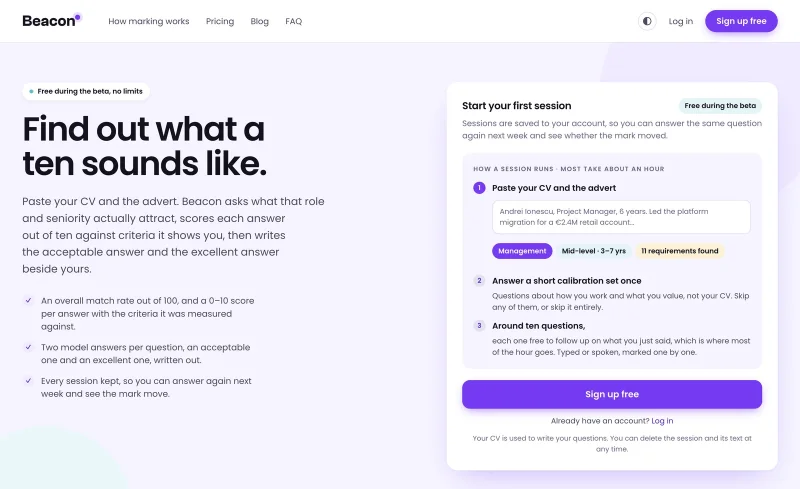
For structured feedback without arranging someone else's evening, that is roughly what Beacon was built for. You paste your CV and the real job advert, it generates questions for that role and seniority, and it marks each answer out of ten against criteria it shows you rather than hides. Behavioral answers are assessed against STAR, so you can see which of the four parts you keep under-serving, and it writes an acceptable and an excellent model answer beside your own. Answers can be typed or spoken, and spoken ones are transcribed and marked identically. Sessions are kept, so you can answer the same question again next week and compare. Free during the beta, no card, no limits.
On the day
Beforehand, skim your story list rather than rehearsing the stories themselves. You want the titles available, not the wording.
Listen for the competency behind the question before you pick a story, because the same prompt can be aimed at two different things. Take two or three seconds before you start. A short pause reads as considered, and it beats starting a story you then abandon. When you finish, it is fine to ask whether they wanted more detail on any part.
If you blank, say so and buy a moment: "Let me think about which example fits best." That is unremarkable to an interviewer. If nothing exact comes, offer the adjacent experience and name the difference yourself. Saying which parts transfer beats forcing a story that does not fit.
What it comes down to
Behavioral interviews test two things at once: whether you have done the work, and whether you can explain it to someone who was not there. The second is a skill, it is trainable, and most candidates never train it because practicing talking about your own experience feels like cheating. It is not. The stories are true either way. Preparing just means you get to tell them well.