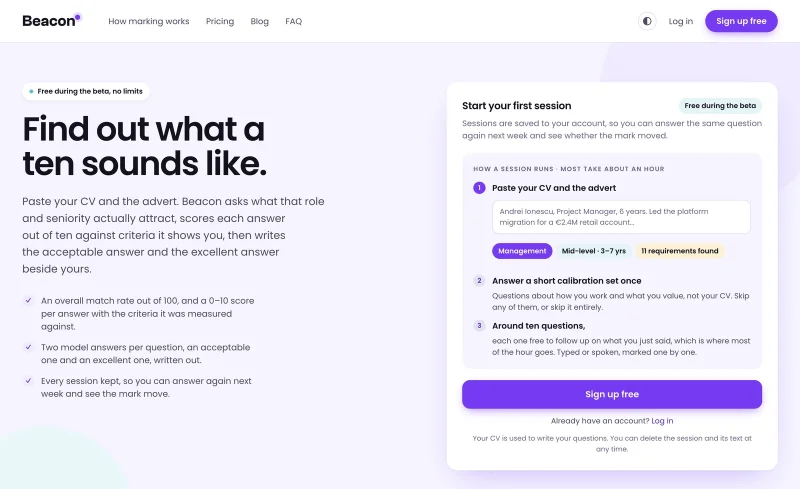
What is Beacon? Building an AI Interview Prep Tool That Actually Works
After conducting hundreds of technical interviews as an engineering lead, I noticed that talented engineers often failed not because they couldn't code, but because they struggled to communicate effectively under pressure. We built Beacon to address this issue with structured AI feedback on both technical answers and communication patterns.



In this article · 9 sections
- The Problem With Existing Interview Prep
- How Beacon Actually Works
- What Beacon Can't Do (Honest Limitations)
- Who Actually Benefits From This
- The Learning Science Behind It
- Privacy and Data Handling
- Getting Started
- Roadmap: What's Coming Next
- Why We Built This
Practise for your next interview free, with no card.
Sign up freeAs an engineering lead who's conducted hundreds of technical interviews over the years, I've noticed a pattern that bothers me.
Incredibly talented engineers (people who could architect complex systems, debug production issues, and mentor junior developers) would completely freeze in interviews. Not because they were unable to do the work. Because they couldn't articulate their thinking under pressure.
Meanwhile, candidates with solid (but not exceptional) technical skills who could communicate their thought process clearly would sail through.
The gap between being a great engineer and performing well in interviews is real. And frankly, most interview prep tools don't solve it.
The Problem With Existing Interview Prep
Let's be honest about what's out there:
LeetCode and similar platforms are excellent for algorithm practice. But they don't teach you how to explain your thinking out loud, handle clarifying questions, or discuss trade-offs with an interviewer.
Generic AI chatbots like ChatGPT can generate practice questions all day. But they lack:
- Structured feedback frameworks (like the STAR method evaluation for behavioral questions)
- Context about your specific background and target role
- Adaptive difficulty that evolves with your performance
- Analysis of your communication patterns, not just your answers
Human interview coaches offer valuable feedback, but they come with a significant cost (hundreds of $$$/hour), are not always available when needed (such as at 11 pm before an early morning interview), and their quality can vary significantly between coaches.
Practicing with friends can be awkward, and unless they're experienced hiring managers in your field, their feedback may not accurately reflect what actual interviewers look for.
We needed something different. A solution that combines the scalability of AI with the structured feedback quality of a professional coach.
How Beacon Actually Works
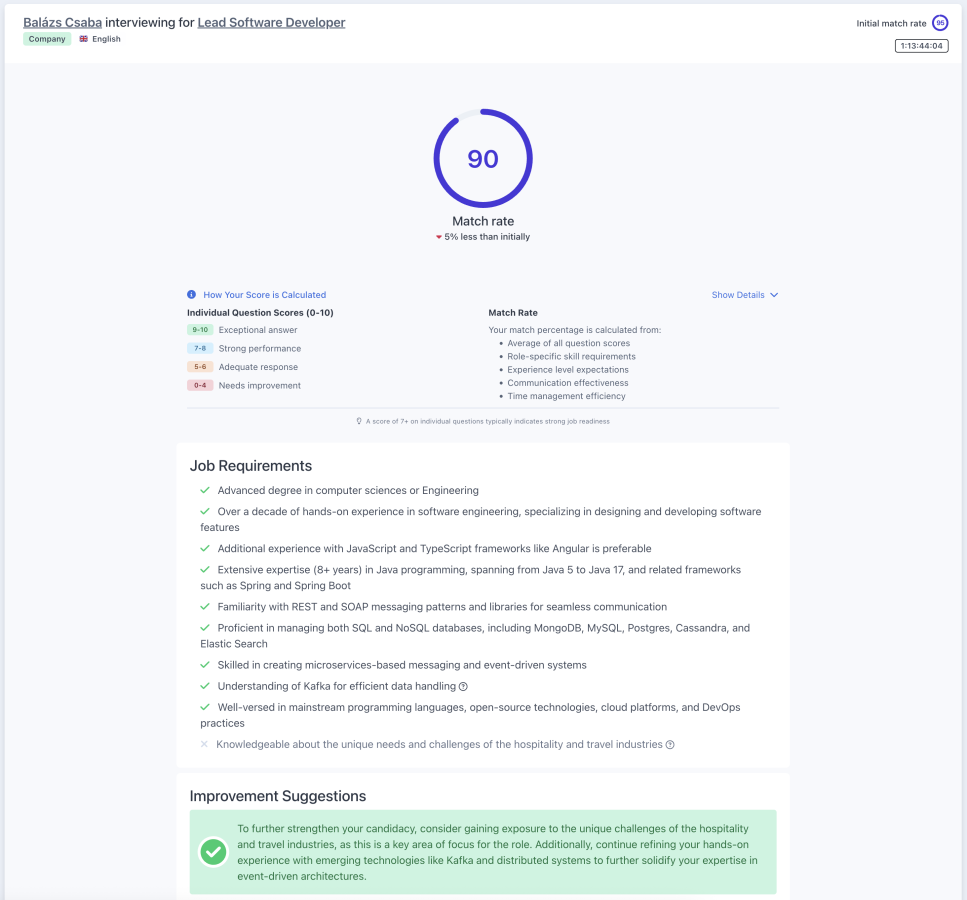
Resume-to-Job Matching
When you upload your resume and a job description, Beacon goes beyond keyword matching. The AI analyzes:
- Which of your experiences are most relevant to this specific role
- Gaps between what you have and what they're asking for
- How to frame your background for this particular position
If you're transitioning from backend engineering to engineering management, Beacon understands you need to reframe "technical architecture decisions" as "technical leadership and mentorship."
This contextual understanding informs every question it generates and every piece of feedback it provides.
Question Generation Based on Real Interview Data
Questions are categorized by:
- Role (Software Engineer, Engineering Manager, Tech Lead, etc.)
- Level (Junior, Mid, Senior, Staff, Principal)
- Company type (Big tech, startup, enterprise, consulting)
- Interview type (Behavioral, technical, system design, cultural fit)
You're not practicing generic questions. You're practicing questions that will actually show up in your interview pipeline.
Structured Feedback That Actually Helps
This is where Beacon differs significantly from other tools.
Most platforms provide feedback that's either "good answer" or "needs improvement." That's useless feedback.
Beacon analyzes multiple dimensions:
For behavioral questions:
- STAR Structure: Are you spending 60-70% on Action, or are you over-explaining the Situation?
- Specificity: Are you saying "we improved performance" or "I reduced API latency from 800ms to 200ms"?
- Personal contribution: Are you using "I" or hiding behind "we"?
- Quantified results: Do you have actual numbers and metrics?
For technical questions:
- Problem clarification: Did you ask about constraints and edge cases?
- Approach explanation: Did you discuss your reasoning before coding?
- Communication clarity: Are you thinking out loud or coding in silence?
- Complexity analysis: Can you articulate time and space complexity?
- Trade-off discussion: Are you considering multiple approaches?
Example of actual feedback:
"The candidate provided a highly detailed and technically proficient response, demonstrating a strong understanding of microservices architecture. They addressed key aspects such as domain-driven design, inter-service communication, containerization, and orchestration.
The use of distributed tracing tools and event-driven architectures shows a practical implementation of advanced concepts. The response also reflects experience in handling complex challenges like data consistency and service discovery, which aligns well with the job requirements.
Communication is clear and structured, making it easy to follow the thought process. However, the answer could be improved slightly by including specific examples from past projects to better illustrate the application of these concepts and tools."
That's actionable feedback you can immediately apply.
Adaptive Difficulty Engine
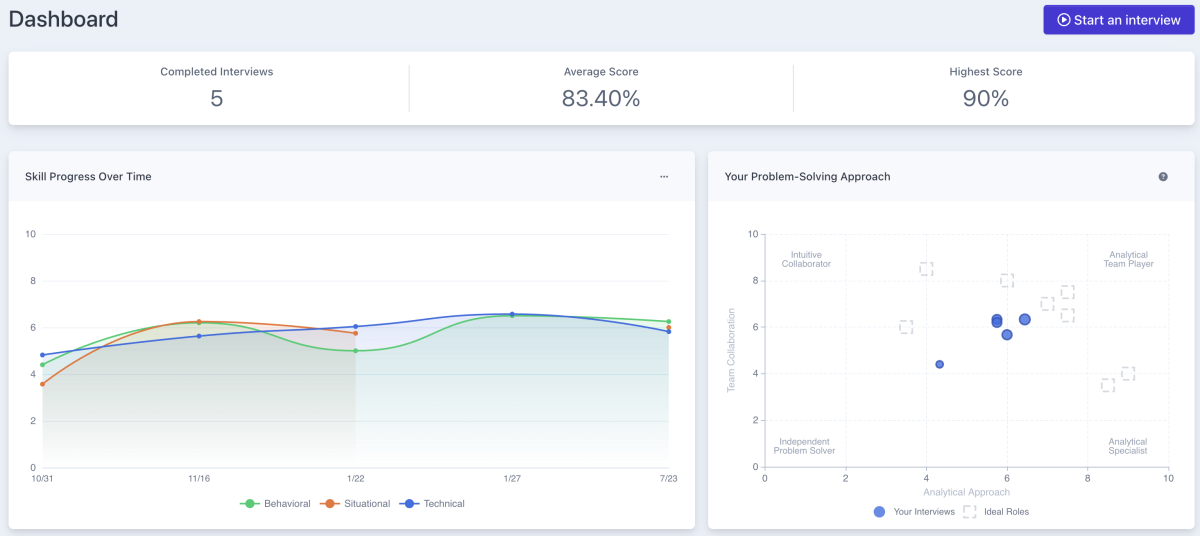
Beacon tracks your performance across question types and adjusts accordingly:
- If you're nailing behavioral questions but struggling with system design, it shifts focus
- If you consistently handle mid-level questions well, it increases to senior-level complexity
- If you're stuck on a particular pattern (like conflict resolution questions), it brings those back at calculated intervals
The adaptive engine ensures you're always practicing at the edge of your ability: not too easy, not impossibly hard.
Practice Modes
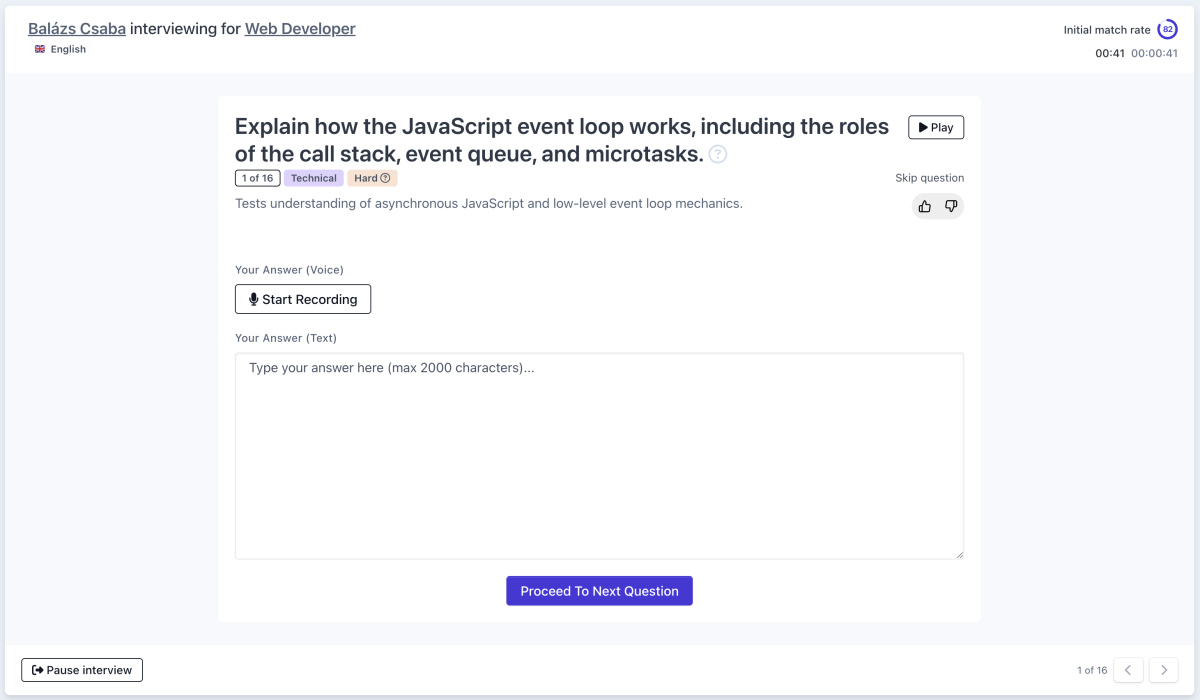
Beacon supports multiple practice formats:
- Text mode: Type your answers to practice structure and content
- Voice mode: Speak your answers to practice delivery and pacing
- Timed mode: Simulate real interview pressure with time constraints
- Mixed mode: Random questions to practice thinking on your feet (will come soon)
What Beacon Can't Do (Honest Limitations)
Let me be clear about what this tool isn't:
It won't make you qualified for jobs you're not ready for. If you're a mid-level engineer interviewing for a Staff position, no amount of interview practice will bridge that experience gap. You need to build the actual skills first.
It can't predict every question. Some interviewers ask unusual, company-specific, or off-the-wall questions. Beacon prepares you for approximately 80-90% of what you'll encounter, rather than 100%.
It won't replace networking and referrals. Having someone advocate for you internally still matters. Beacon helps you avoid blowing the interview once you land it.
It's not a real-time interview assistant. Unlike tools that whisper answers during actual interviews, Beacon focuses on building lasting skills. The goal is to genuinely improve your interviewing skills, rather than relying on a tool.
Who Actually Benefits From This
Engineers Who Interview Rarely
If you've been at one company for 5+ years, interviewing feels foreign. Your technical skills are sharp, but your interview skills have atrophied. Beacon helps rebuild those muscles without the awkwardness of bombing real interviews.
Career Transitioners
Moving from IC engineer to engineering manager? Backend to full-stack? Big tech to startup? You need to reframe your experience for the new context. Beacon helps you articulate transferable skills in interview-appropriate language.
Non-Native English Speakers
If English isn't your first language, the added cognitive load of thinking in a second language while solving technical problems can be overwhelming. Practice helps build fluency and confidence in technical communication.
Engineers With Interview Anxiety
Some brilliant engineers shut down under interview pressure. Repeated practice in a low-stakes environment desensitizes the anxiety response and builds confidence.
The Learning Science Behind It
We did not just build features. We designed Beacon around proven learning principles:
Deliberate Practice
Research from Anders Ericsson shows improvement comes from:
- Focused practice on specific skills
- Immediate feedback on performance
- Progressive difficulty increase
That's precisely how Beacon is structured.
Spaced Repetition
Questions you struggle with return at calculated intervals. This leverages the spacing effect: information is better retained when exposure is distributed over time rather than crammed.
Metacognition
By providing detailed feedback on your thought process (not just the final answer), Beacon helps you develop metacognitive skills, thinking about how you feel and solve problems.
Privacy and Data Handling
As someone who takes GDPR seriously (we've implemented it at Human Direct), privacy was a design priority:
- All practice data is encrypted at rest and in transit
- Your data is never shared with employers or third parties
- You can export or delete your data at any time
- We're compliant with GDPR, CCPA, and relevant data protection regulations
- Practice sessions are stored to track improvement, but you control retention policies
Getting Started
During beta, Beacon is completely free. Here's the recommended approach:
- Upload your resume and target job description - Let Beacon analyze the match
- Start with one practice session daily (20-30 minutes is sufficient; you can pause the interview)
- Focus on your weakest areas first - The feedback will tell you where to improve
- Use voice mode for behavioral questions - This simulates real interview conditions
- Review feedback immediately - Don't wait; learn while it's fresh
Most users see noticeable improvement within 5-7 focused practice sessions.
Roadmap: What's Coming Next
We're actively developing several features:
- Company-specific preparation: Custom question sets for companies with unique interview processes
- Video practice mode: Record yourself to practice body language and presence
- Team accounts: For companies wanting to help their employees prepare for internal promotions
- Integration with ATS systems: Help recruiters prep candidates before sending them to clients
If you have feature requests, we're listening. Seriously. Please email us.
Why We Built This
I've been on both sides of recruitment, as an engineering lead hiring teams and as co-founder of an IT recruitment agency. I've seen too many talented people struggle in interviews for reasons that have nothing to do with their actual capabilities.
The interview process is imperfect. But it's what we have. By helping people present their skills more effectively, we improve outcomes for both candidates and companies.
Beacon is about making the interview preparation process more efficient, more effective, and more accessible. Just as we leveraged technology to scale our recruitment operations at Human Direct, we're now using it to scale quality interview preparation.
Because interviewing is about people, business is about growth. Technology is about making our lives easier.
Ready to practice? Sign up for free during beta and get instant access to personalized interview preparation.
Questions about how it works? Check our FAQ.